

Inclusive Education Services:
The growing number of children with disabilities who are vulnerable to neglect, abandonment, and discrimination and who still do not have access to their neighborhood regular schools calls for greater concern. A human being cannot attain his full potentials and heights until he is educated because education remains a very strong weapon for development. Yet many children with disabilities in Low and Middle Income communities remain deprived of the opportunities to be enrolled in their neighborhood schools as a result of attitudinal and environmental barriers, lack of policies and trained teachers in special education.
The challenge(Facts & Figures).
The Education for ALL (EFA) Global Monitoring Report(UNESCO 2009) estimates that between 93 million and 150 million children around the globe live with a disability. This report published by UNESCO considers disability as “one of the least visible but most potent factors in educational marginalization”, among all other marginalized population.
-90 % of children with disabilities who do not attend school at all live in developing countries;
-children with disabilities are more likely to drop out of school than their non-disabled peers as a result of barriers, negative attitude from teachers, school administrators, peers and stigma from parents;
-children with disabilities who are fortunate to attend school are more likely to be enrolled in targeted segregated special schools located only in major towns and cities, which reinforce marginalization. What becomes of the majority of children with disabilities who cannot afford to go to school in cities?
-The UNDP statistics estimate that while the global literacy rate for adults with disabilities is 3%, just 1% of women with disabilities are literate;
-people with disabilities who fail to attend school as a child are more likely to live a life of complete and perpetual poverty and total dependence once they become adults;
-children with intellectual, developmental and sensory impairment are the least likely group to attend school;
-again, girls with disabilities in developing countries are almost invisible in existing education and vocational training programs as they face exclusion from education and risks such as sexual violence.
Our response
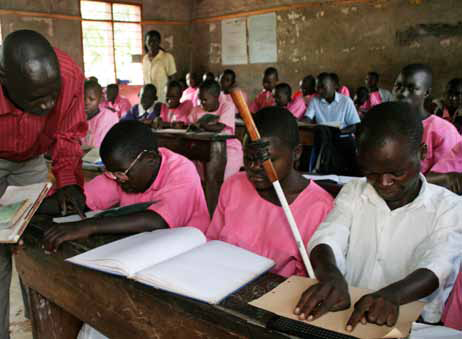
An Inclusive classroom for the disabled and non-disabled students.
As part of its strategy to enhance the inclusion of children with disabilities in their neighborhood schools, MORE ACTION engages in the following activities:
-work in collaboration with partner organizations, DPOs, CBOs and institutions specialized in rehabilitation and education services to organize awareness raising campaigns on the essence of inclusive education in our neighborhood schools;
-organize training workshops to train more teachers and school administrators on the Special Education Needs of CWDs (braille, sign language etc), and to build awareness among teachers and education providers on the rights to educate CWDs;
-work with education stakeholders towards improving policies on Inclusive education;
-partner with the Ministries of Social Affairs, Education, UNESCO and Health to promote, improve and implement policies on inclusive education;
-identify the number of children with disabilities in each community by meeting local people with disabilities and DPOs and CBOs, collecting better quality data that explains the different disabilities and impairments as well as the level of severity. This will be used for effective planning and design of programs, policies and timely intervention;
-work with early childhood educators and providers on identification and inclusion of young children with a disability to maximize inclusion from early age;
-forming Parents/Community Support Groups to ensure the involvement of parents and the entire community in the education of their children with disabilities;
-help the government design data collection instruments and programs to take stock of the number of disabled children who are out of school and elaborate relevant education programs to integrate them into their neighborhood schools.
Humanitarian/Emergency Response Services:
The Challenge(Facts & Figures).
Following and outbreak of an emergency, people with disabilities become very invisible as they are often left out in the process of Disaster Risk Reduction (DRR).
Apart from experiencing the loss of adaptive equipment or assistive devices such as glasses, wheelchairs, aid, and inadequate relief and support, they also find it very difficult in accessing shelter and safe places due to attitudinal and environmental barriers.
-The WHO estimates that conflict remains the eight most common cause of disability world wide;
-15% of any disaster-affected population will be persons living with disabilities;
-about 3.5 million refugees and Internally Displaced Persons(IDPs) live with a disability world wide;
-for every 1 person killed in a disaster, another 3 persons are injured or left with a permanent disability;
Our Response
At MORE ACTION, once a disaster strikes, the response follows immediately. Our experienced Inclusive Humanitarian Response Team(IHRT) ensures the timely supply of basic needs like assistive devices, food, water, logistics, shelter, medication and safety.
We provide Short -Term and Long-Term recovery efforts to persons with disabilities in communities that have been trapped into conflict and natural disasters.
We stand with the families of affected persons with disabilities as they struggle to rebuild their lives after disaster outbreak. We do this by:
-working and partnering with Disabled Persons Organizations(DPOs) and other CBOs to identify what is needed so as to increase resilience and reduce risks. This will ensure the implementation of disability inclusive emergency response and to ensure that No one is left behind when aid is provided. Our volunteers work collaboratively with partners who are specialists in providing education in emergency services, health care, nutrition, shelter etc for persons with disabilities during emergencies.We work with local partners to ensure that persons with disabilities are included in all the phases of disaster preparedness , response and recovery;
-ensuring that persons with disabilities are located and reunited with their family members near accessible facilities;
-ensuring that camps, shelters and other facilities meet Universal Standards;
-ensuring the accessibility of food distribution points and the registration of persons with disabilities, types of disabilities;
-ensuring that the needs and requirements of children and adults with disabilities are prioritized and addressed urgently;
-ensuring the inclusion of gender-based violence protection activities for women with disabilities;
-ensuring that information on aid distribution and relief activities is produced in a variety of forma. For example, pictures, posters, audio,radio, plain language etc.
-ensuring that community consultation is occurring at a time and place accessible to people with disabilities;
-addressing the negative attitudes of program staff relating to persons with disabilities;
During the recovery phase, our experts remain in the affected area to initiate, design and plan long term programs that include persons with disabilities into all aspects of community life such as:
-access to health care and rehabilitation services;
-access to livelihood programs;
-access to education and inclusive vocational training
All our staff and volunteers receive training in Emergency Management, CPR, First Aid. Staff receive ongoing specialized training based on the physical and emotional needs of each person we support.
Our humanitarian work is funded from a range of different sources:
- Private donations from individuals, companies, trusts and foundations.
Training/Capacity Building Services:
At MORE ACTION, our capacity building program is focused much on person-centered disability inclusive development principle. We provide a wide range of courses in the area of disability inclusive development, humanitarian and disaster response that meet the training needs of agencies working to serve persons with disabilities in communities and disaster affected regions.
With the help of a qualified training team that brings well rounded knowledge and passion to its training courses, we strongly believe in building the capacities of staff working with local nonprofits, government organizations and international organizations like the UN, AU, IFRC etc

So our training courses target local nonprofit staff and leaders, community leaders, UN staff, AU staff, managers, stakeholders, teachers, students, etc
Previous Capacity Building Projects.
-Development and delivery of “Building A Better Humanitarian Response” Training course at the Humphrey School of Public Affairs, University of Minnesota(USA).
-Techniques in GRANT WRITING;
-Understanding Disability Inclusion in Humanitarian Response;
-Understanding Global Health issues and Disability;
-Inclusive Education for Learners with Visual Impairment(LWVI);
-Inclusive Education for Learners with Hearing Impairment(LWHI);
-Humanitarian Log Frames;
-Redefining Disability and its relationship to poverty in the Global Development Agenda.
-Understanding Disability Inclusion in the Global Development Agenda
-Health In Humanitarian Crisis
-Understanding Inclusive Education for Children with Disabilities and its benefits;
-What is Entrepreneurial Thinking?
-Understanding Emotional Intelligence.What is Emotional Intelligence?
-Understanding Disability Inclusion in Humanitarian Response
-Understanding the Humanitarian Log Frames
-Understanding Accessibility and Inclusion
Our training is done through seminars and workshops.
Contact the training team at…………………………….. for training purposes.
Employment Assistance and Vocational Training Services:
At MORE ACTION, we provide inclusive vocational training and employment assistance to persons with disabilities.
Persons with disabilities have limited employment and economic opportunities as they face numerous barriers in their communities as a result of their impairment.
Our Response
Inspired by the principle of “living no one behind“,
-we prepare persons with disabilities in vocational training and job search that is inclusive, so that they can become valuable assets and not liabilities in their communities;
-We assist persons with disabilities overcome barriers to employment by creating income generating activities and provide inclusive vocational training to women, girls, men, boys with disabilities;
-Income generating activities like hairdressing, tailoring are provided to single mothers living with disabilities.
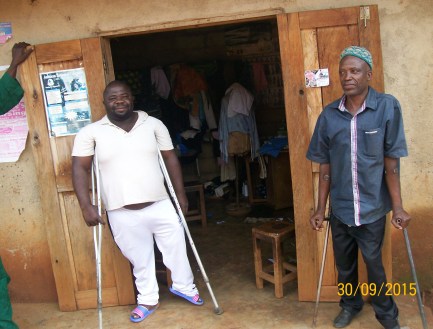
A picture of a tailoring workshop provided by MORE ACTION to assist persons with disabilities live a life of Independence.Courtesy of Mr Chia Emmanuel, Programs Director, Cameroon Country Office.
-We assist persons with disabilities in building a plan to get a job of their choice so they can succeed professionally.
-we empower program participants and provide counseling on income generating activities.
-we also provide links to employers and support employers to work effectively with the persons with disabilities working in their companies.
Advocacy can be many things – from having conversations in your community, to demonstrating on the Capital steps to speaking with your legislator.
“I want all people with disabilities to be treated fairly and with respect. I want to be an example to other people with disabilities and show them how to stand up for themselves and what they want. Sometimes, people with disabilities are misunderstood, I have the opportunity to tell my story and ask for support from lawmakers for more opportunities for people with disabilities.”
Larry receives supports in one of MADI’s home and has a rare platform to raise his voice. He has transformed his experiences living with a disability into a unique learning opportunity for colleagues and lawmakers.”
 more-action.org